Understanding the real drivers of value will save you time and help you keep more of the money you deserve.
What we mean by a junk car
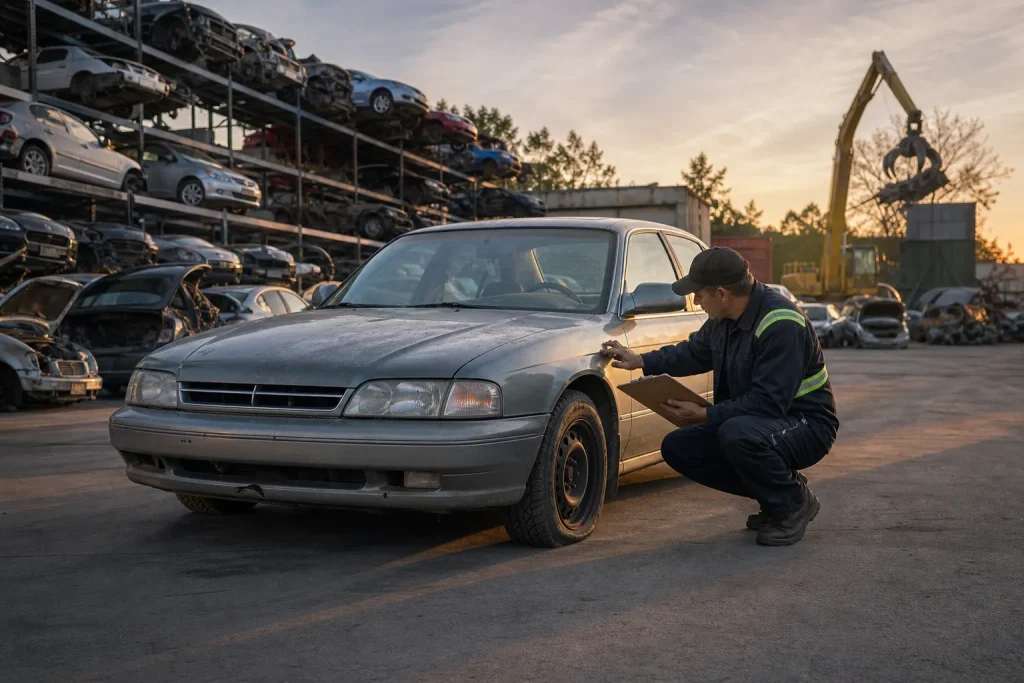
A junk car is a vehicle sold mainly for its salvageable materials or parts rather than for continued use.
In most cases the offer reflects what buyers expect to recover from scrap metal and reusable components.
The market treats two cars that look similar very differently if one is complete and the other is stripped.
The buyer is pricing your car as a resource rather than as a roadworthy product.
Why this market exists
Automotive recycling grew as dismantlers, steel mills, and export terminals created networks that value parts and metal.
Regional hubs and shredder centers made it cheaper to process some cars and more expensive to handle others.
Because processing and transport costs change from place to place the offers for the same vehicle can be very different.
That regional cost structure is a key reason prices vary across the country.
Primary value drivers explained
The five most influential factors are weight salvageable parts condition location and current scrap prices.
Weight matters because most scrap deals start with the vehicle’s metal mass multiplied by a local scrap rate.
Salvageable parts such as a catalytic converter or intact transmission can add significantly to the base price.
Completeness and condition affect whether a buyer can recover parts easily or must invest time and money to do so.
Key factors at a glance
Here is a quick checklist to help you assess what matters before you call buyers.
- Weight: Heavier vehicles usually fetch more because they yield more scrap metal.
- Valuable parts: A catalytic converter or aluminum wheels can dramatically increase offers.
- Completeness: A complete car often beats a stripped one because buyers can remove parts and metal more efficiently.
- Condition: Running cars often get better offers but a complete non-runner may still outperform a stripped running car.
- Location: Proximity to processors and local scrap demand affect what buyers will pay.
- Paperwork: Having a clean title and any required state forms speeds the sale and reduces the chance of last minute issues.
How buyers usually calculate a number
Most buyers start with a simple formula that combines the vehicle’s weight with the local scrap metal rate and then adds salvageable parts.
A rough calculation is vehicle weight in tons times the local per ton rate plus the estimated value of recoverable parts.
After the base calculation buyers adjust for condition transport complexity and missing pieces.
A quoted price may look good until you learn towing will be deducted or a converter is missing at pickup.
| Component | How it affects value | Example impact |
|---|---|---|
| Weight | Sets the base scrap value using a per ton rate | A heavy truck can add hundreds to the base price |
| Catalytic converter | Contains precious metals and can be worth a large share of the car value | Can add several hundred dollars depending on type |
| Completeness | Complete cars reduce labor and part-retrieval costs for buyers | A complete car may be 10 to 30 percent higher than a stripped one |
Why catalytic converters matter more than you might expect
Catalytic converters contain precious metals that are in steady demand and command higher prices than ordinary scrap.
Because of that a single converter can represent a large portion of a small car’s total value.
When a converter is intact your offer can be far better than for the same car with the converter removed.
- Precious metals: They contain platinum palladium and rhodium or a mix of these materials.
- High demand: Recyclers and refineries pay a premium for converters because the metals are scarce.
- Removal risk: Buyers discount cars that need the converter removed carefully or that have had it stolen.
Step by step sales process
Following a standard process reduces stress and prevents common errors during a junk car sale.
- Confirm ownership locate the title and check for liens before getting quotes.
- Assess the car record whether it runs the major missing parts the VIN and mileage.
- Document the vehicle with clear photos of the exterior interior engine bay odometer and any damage.
- Get multiple quotes compare them on a net basis and verify whether towing is included.
- Agree pickup details schedule a time and only sign the title after you accept the final amount.
- Complete any required state forms file a release of liability and cancel insurance after the transfer.
Paperwork and legal safety
A valid title is often the most important single item buyers will ask for.
Some states allow sales without a title in special circumstances but those options carry risk and extra steps.
Never sign over a vehicle until you have agreed on the price and the buyer is present to complete the transfer.
Towing and logistics matter more than you expect
Towing distance accessibility and whether the car rolls affect the buyer’s expenses and your net payout.
Some buyers advertise free towing while others deduct hauling costs or charge for difficult recoveries.
Always confirm who pays if the car is stuck in mud locked on private property or has four flat tires.
| Scenario | Typical buyer response | How to protect your net payout |
|---|---|---|
| Car rolls and is accessible | Often free pickup included | Confirm free towing in writing |
| Car does not roll or is inaccessible | Buyers may charge for recovery or lower the offer | Ask for a firm in-person quote and an estimate for extra charges |
| Long distance to yard | Some buyers deduct mileage from the quote | Get a quote that explicitly states whether distance is deducted |
Pros cons and realistic considerations
Selling to a junkyard is fast and convenient but it may not always produce the maximum cash if you could part out the vehicle yourself.
Parting out a car can yield higher total return if you can find buyers for valuable components and you have the time and tools.
Recycling offers environmental benefits because metals and parts are recovered and reused by industry.
| Option | Pros | Cons |
|---|---|---|
| Selling to a junkyard | Fast sale immediate payment often free pickup | Lower payout than selling parts individually |
| Parting out yourself | Potential for higher total return with valuable parts | Requires time skill tools and storage space |
| Recycling through a processor | Environmentally responsible recovers materials | Offers vary by region and market conditions |
Common mistakes people make
Avoiding these common errors will keep the sale smooth and protect your money and liability.
- Accepting the first quote without comparison can leave money on the table.
- Forgetting the title or not resolving a lien can derail the sale at pickup.
- Leaving valuables and paperwork in the car creates loss risk and slows the transfer.
- Comparing offers without checking whether towing is included or will be deducted.
- Misrepresenting the car’s condition which often leads to revised offers at pickup.
Examples and case studies to make it real
A heavy pickup truck in a steel mill region may command a higher base scrap value than the same truck in a remote market.
A small sedan with an intact catalytic converter and aluminum wheels can produce an offer that outpaces a stripped larger car.
Two identical non-running cars in different cities will often see different quotes because of local processing and transport costs.
Final tips and conclusion
Start with the paperwork before you call buyers because a clean title simplifies everything.
Take good photos include the VIN and list missing parts to reduce surprises at pickup.
Always get at least three quotes and compare them on a net basis to understand the real money you walk away with.
Ask whether towing is free whether there are condition-related fees and who handles DMV forms.